
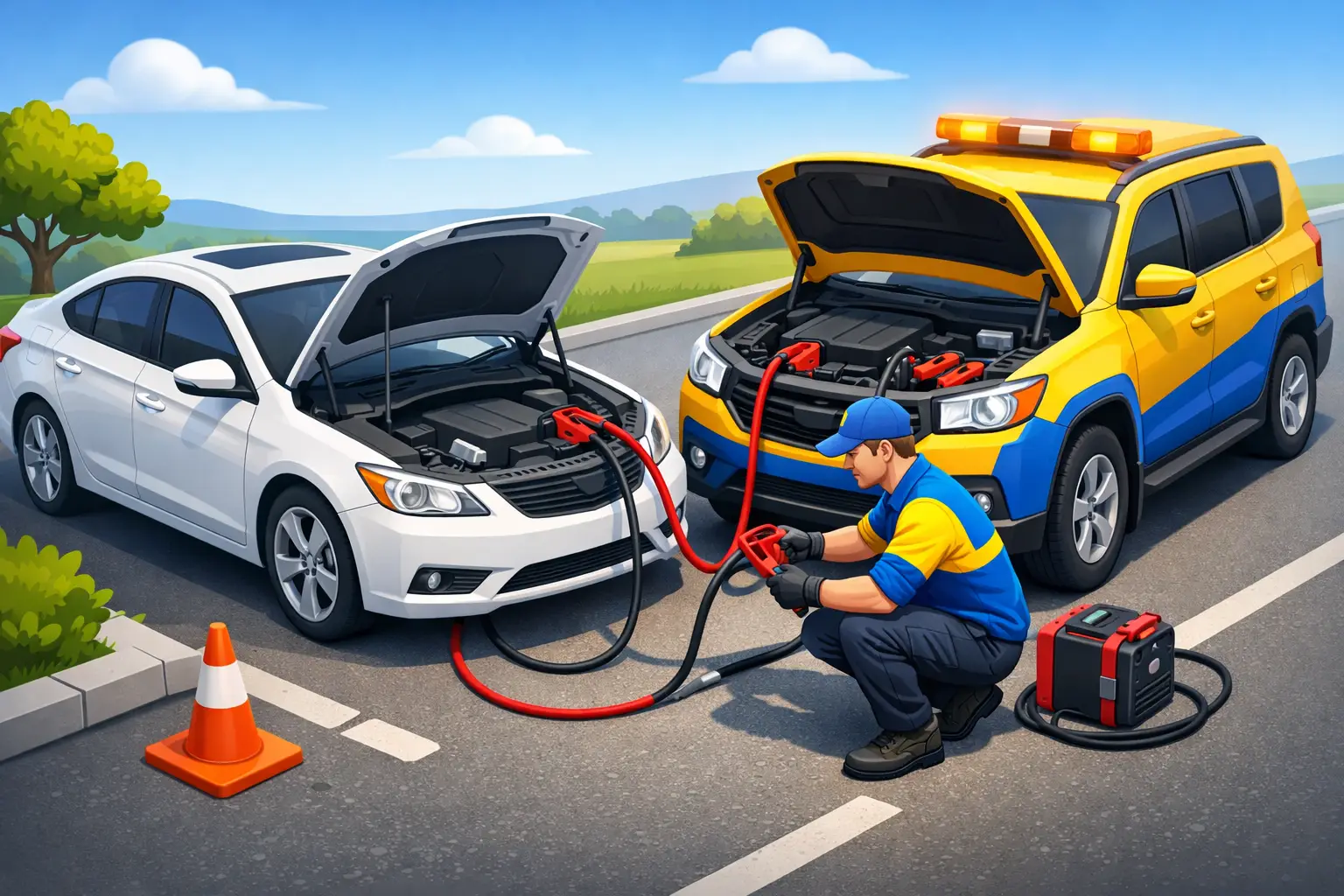
That moment when you turn the key or press the start button and get nothing but a click can ruin your whole day fast. If you have ever wondered how roadside jump starts work, the short answer is simple: a technician uses an outside power source to give your battery enough energy to start the engine, then checks whether the battery is likely to hold a charge or fail again.
The part most drivers do not see is that a proper jump start is not just hooking up cables and hoping for the best. A good roadside service starts by making sure the battery is really the problem, the connection points are safe to use, and the vehicle can be started without creating a bigger issue. That matters on a dark shoulder, in a parking lot, or anywhere traffic and stress are already high.
How roadside jump starts work in real life
A vehicle battery stores electrical power used to start the engine and run electronics when the engine is off. When the battery charge drops too low, there may not be enough power to turn the starter motor. A roadside jump start temporarily supplies that missing power.
Most professional roadside providers use a portable jump box rather than another vehicle. The jump box delivers a controlled burst of power directly to the dead battery system. Once connected correctly, it helps the starter crank the engine. After the engine starts, the alternator takes over and begins charging the battery again.
That is the basic process, but the details matter. If the battery is cracked, leaking, badly corroded, frozen, or connected to a system with another electrical fault, a jump start may not be the right move. In some cases, the vehicle may start and shut off again right away. In others, the battery may be so weak that it cannot recover.
What a roadside technician checks first
Before any cables go on, an experienced operator usually looks at the bigger picture. If the headlights are dim, the dash is flickering, or the car only clicks once, a weak battery is likely. But if there is no power anywhere in the vehicle, the issue could also involve battery terminals, a blown main fuse, or a connection problem.
The technician will usually inspect the battery for visible damage, heavy corrosion, or loose terminals. They may also ask what happened before the car died. Did it sit for days? Was a dome light left on? Has the battery been slow to start all week? Those details help tell the difference between a drained battery and a battery that is simply at the end of its life.
Safety comes first here. Batteries can release flammable gases, and incorrect cable placement can damage vehicle electronics. That is one reason professional roadside help is often safer than trying to figure it out alone in a rush.
The jump-start process step by step
Once the battery and vehicle are checked, the technician positions the jump box or service vehicle safely and turns off unnecessary electrical loads in the disabled car. That usually means lights, radio, climate control, and chargers.
Next comes the cable connection. The positive clamp goes to the positive battery terminal. The negative side is connected according to safe procedure for that vehicle, which may be the negative terminal or a designated grounding point. Many newer vehicles have specific jump-start points under the hood, and using the right one matters.
After the equipment is connected, the technician allows the system to stabilize for a moment. Then they attempt to start the vehicle. Sometimes it starts right away. Sometimes it takes a minute or two of charge support first, especially if the battery is deeply drained.
If the engine starts, the technician may let it run briefly and watch for obvious warning signs. If the vehicle does not start, they may recheck the connections, confirm battery condition, or consider whether another problem is preventing ignition. A dead battery is common, but it is not the only reason a car will not start.
Why a jump start sometimes works only once
A lot of drivers assume that if the engine starts, the problem is solved. Sometimes that is true. If you accidentally left interior lights on overnight, the battery may just need a good recharge.
But sometimes a jump start is only temporary. Older batteries can lose their ability to hold a charge, especially in cold weather or after repeated drain-downs. If your car needs another jump a few hours later, the battery may be failing, or the alternator may not be charging properly.
There is also a difference between a discharged battery and a bad battery. A discharged battery still has life left once recharged. A bad battery may accept a jump just long enough to start the engine, then drop off again. That is why roadside help is not just about getting you moving. It is also about helping you understand whether you can drive confidently or should head straight to a repair shop.
How roadside jump starts work on newer vehicles
Newer vehicles can be more sensitive than older ones. Many have start-stop systems, battery monitoring sensors, and tightly packed engine bays with remote terminals instead of easy battery access. Hybrid and electric vehicles add another layer, since they can have both a 12-volt battery and a high-voltage system.
That does not mean they cannot be jump-started. It just means the procedure has to match the vehicle. On some cars, using the wrong connection point can trigger electrical issues or fail to start the vehicle at all. On hybrids, the small 12-volt battery may power the electronics needed to engage the main system, but the approach still has to follow the manufacturer layout.
This is one of those situations where experience really matters. Local roadside operators who handle a wide range of vehicles every week tend to recognize these differences quickly.
When a jump start is not the right fix
There are times when a jump start should not be attempted or will not solve the actual issue. If the battery case is swollen, cracked, leaking, or smells strongly of sulfur, it may be unsafe to energize. If the vehicle was in a collision, electrical damage could also be a factor.
If the engine cranks normally but still will not start, the issue may be fuel delivery, ignition, or another mechanical problem. If there is a rapid clicking sound, heavy corrosion, or signs of rodent damage under the hood, the problem could go beyond battery power.
In those cases, towing may be the better next step. A dependable roadside company should be honest about that instead of treating every no-start call like it only needs a jump.
What drivers can do after the vehicle starts
Once the car is running, the next step depends on why the battery died. If the drain was clearly caused by something left on, driving for a while may help recharge it. Even then, a short trip may not be enough. Modern vehicles use a lot of power, and alternators are not designed to recover every deeply drained battery quickly.
If the battery is more than a few years old, or the starting trouble has happened more than once, get it tested soon. Do not assume a successful jump means the battery is healthy. Waiting too long can leave you stranded again at work, at home, or on the side of the road.
It also helps to limit extra electrical load right after the jump. Keep unnecessary accessories off for a bit, and pay attention to warning lights. If the battery light stays on, that points to a charging-system issue, not just a low battery.
Why professional roadside help makes a difference
A jump start sounds simple until you are doing it in rain, traffic, darkness, or cold weather with a vehicle that will not cooperate. Professional roadside service brings the right equipment, the right safety steps, and the judgment to tell whether the car can be started safely.
For drivers in Marysville and across Snohomish County, that local experience matters too. A company like Richard’s Towing Inc knows the area, responds around the clock, and understands that most people calling for a jump start are not looking for a lesson in battery chemistry. They want fast help, clear answers, and a technician who treats them with care.
If your vehicle will not start, the goal is not just to get the engine running for a moment. It is to get you back on the road safely, or help you make the right next move if a jump start is only part of the problem. That little click from the ignition can mean a few different things, but with the right roadside help, it does not have to turn into a bigger headache.